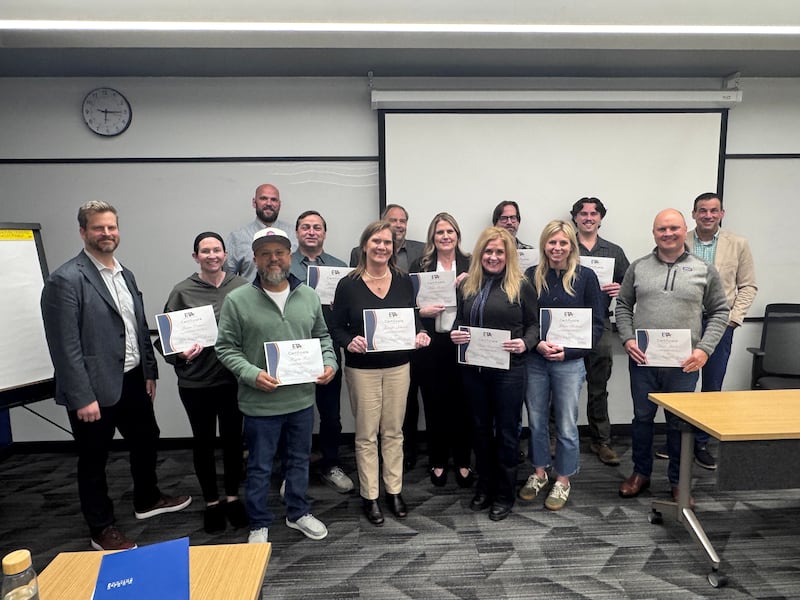
As the Baby Boomer generation enters retirement age, trillions of dollars in businesses are expected to transfer to a new generation. McHenry County Economic Development Corporation launched a set of programs in hopes of keeping local dollars local when such generational shifts occur.
Launched last year, the Strong Transitions program helps both business owners looking to sell and entrepreneurs looking to acquire. MCEDC Executive Director Mark Piekos said he was inspired to develop the programs after noticing a gap in their services that didn’t bridge the transition process between seller and buyer.
And such bridges will only get more common. Piekos said an estimated $14 trillion of business equity is expected to transfer nationally over the next 10 years. It’s commonly called the “silver tsunami” or the “gray wave” because the Baby Boomer generation in or heading toward retirement.
“There definitely were indicators, and we saw it anecdotally in McHenry County, and we thought this program would be an appropriate solution, or at least [a] resource, for that,” Piekos said.
With the programs, Piekos said the goal is to ensure the companies and jobs within the county stay.
“We definitely all have a stake in retaining these businesses, and if we don’t educate the next generation of entrepreneurs, then we run the risk of losing those forever,” he said.
Strong Transitions is funded through COVID-19-era Advance McHenry County funds under the American Rescue Plan Act, which must be fully spent by the end of this year. Though the funding is sunsetting, Piekos has full intentions to keep the programs running and to find other sources to fund them.
Strong Transitions has two programs: an eight-week training course called Entrepreneurship Through Acquisition, and Transition Advising in partnership with the Illinois Small Business Development Center at McHenry County College.
Since March of last year, over 40 business owners have utilized the advising, and over 60 have graduated from the training course.
Teaching the next generation
The Entrepreneurship Through Acquisition program, known as ETA for short, covers buying and growing a business for aspiring entrepreneurs, what Piekos likes to call “wantrepreneurs.” The classes are held at McHenry County College’s Catalyst Campus, located at 222 E. Church St., Woodstock.
ETA instructor and facilitator Bryan Esarco uses the Harvard Business School textbook “Guide to Buying a Business” and incorporates hands-on learning to teach students how to search for businesses, how to run them and everything in between.
There’s also matchmaking involved in the process in order to find a good fit between the business and the buyer.
“Sometimes the hard part is identifying what you want to buy,” Esarco said. “Because it’s not just about buying a business. You want to be passionate about it too.”
The ETA program is personal to Piekos. He went through a rocky transition when he abruptly inherited his father’s business with his mother in 2016 after his father unexpectedly died. Piekos hopes this program will provide second-generation families with the resources for a smooth and planned transition.
“At that point in my life, I had never seen a balance sheet. I have never seen a profit-loss statement,” he said. “It was like, ‘Wow. We have to figure out how to run this thing.’”
Planning for the ‘silver tsunami’
The second prong in the Strong Transitions program is utilizing the Illinois Small Business Development Center’s year-round, no-cost, confidential advising for business owners.
John Mink of the Illinois Small Business Development Center at MCC matches business owners with advisors in hopes of keeping businesses from dying, breaking up or moving out of the county.
“We can help anybody throughout their entire business cycle,” he said.
In recent years, Mink has seen an uptick in business owners looking to sell.
“The hands are quite full,” he said.
Piekos and the Strong Transitions team aim to continue to refine and grow the program. Just over a year in, they have adjusted to meet business needs, like adding education for smaller businesses.
“We really prioritize making sure that we’re working with the whole business, the whole business owner and not just being steeped in just the numbers,” Piekos said. “The numbers are important, but the people are more important.”
Piekos said he hopes the programs catch on and inspire other regions and counties to launch their own. He has already heard from other economic development communities around the state showing interest in the programs.
“I hope that people copy us,” he said. “Let’s impact this issue that is of huge magnitude with programs like this because it does serve the business community well.”