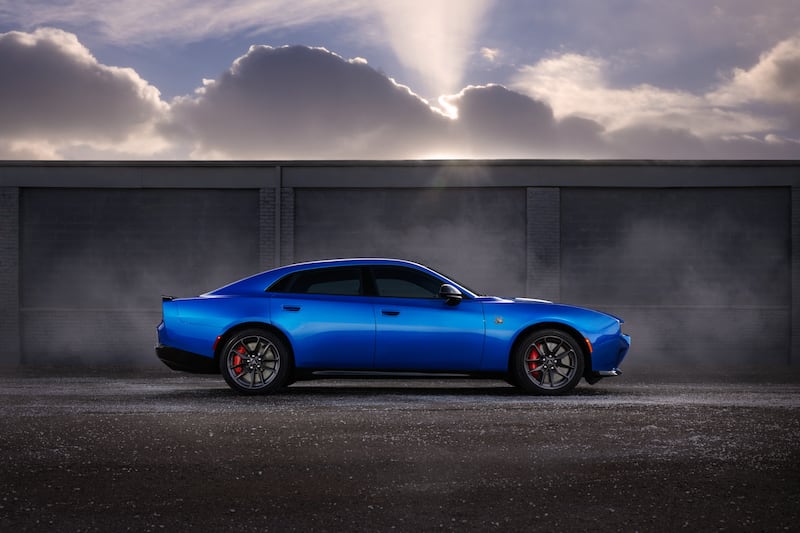
The 2026 Dodge Charger Daytona Scat Pack doesn’t just mark a new chapter for Dodge’s most recognizable nameplate – it rewrites the format entirely. With four doors, electric propulsion and quarter-mile capability deep into the 11-second range, this Charger is less about nostalgia and more about redefining what modern American muscle can be.
My tester arrived loaded with the Scat Pack and Track Package, pushing the price well beyond the $61,995 base to a fully optioned $80,455, including destination. That figure includes the Track Package ($4,995), Sea and Sound Group ($2,495), Carbon and Suede Package ($1,995), Bludicrous paint ($795), and performance tires ($795). It’s a big number – but this is also a very big performance statement.
Muscle car DNA
From my perspective, there is only one place to start: straight-line performance. The Charger Daytona Scat Pack is simply breathtaking when you put your foot down. Power comes from 400V G2500 front and rear electric-drive motors paired with a front/rear offset one-speed gearbox, delivering instantaneous torque in a way internal combustion simply can’t replicate.
My tester delivered a level of acceleration that is violent, immediate and addictive. This is a family sedan that can embarrass a long list of traditional performance cars at the drag strip – and do it with four doors and usable rear seating.
Despite its size and weight, the Charger Daytona never feels sluggish. The Track Package’s high-performance suspension keeps body motion in check, while massive Brembo high-performance brakes provide confident stopping power. Grip from the optional performance tires was excellent, helping the car launch cleanly and stay planted through whatever aggressive driving I could muster among the Chicagoland region’s porous pavement.
Make no mistake, this is a muscle car reinterpreted, not diluted. Dodge deserves credit for making the Charger Daytona feel emotionally engaging rather than just “EV-fast,” which is a pitfall of many high-performance EVs on the market.
Style
Where some EV performance cars look generic or overly futuristic, the Charger Daytona absolutely nails its exterior presence. The wide stance, aggressive proportions, and unmistakable muscle-car silhouette make it instantly recognizable as a Dodge. The Bludicrous paint added notable visual drama, highlighting the sculpted body without getting too cartoonish.
From nearly every angle, the Charger Daytona looks like it belongs in the muscle car lineage. That alone sets it apart in an EV market often dominated by sleek-but-soulless shapes.
Surprisingly, one of the Charger Daytona’s most underrated strengths was its practicality. With two more doors than any traditional two-door muscle car, this is genuinely usable as a family hauler. Rear-seat access is easy, passenger space is generous, and the trunk offers great cargo capacity.
With its dual personality (school drop-offs during the week, 11-second quarter-mile runs on the weekend), there is nothing on the road that can replicate the wide swath of performance and roominess. For buyers who want speed without sacrificing everyday usefulness, the Charger Daytona makes a compelling case.
Interior pause
Getting behind the wheel in the cabin offers a bit of an upscale feel, as some materials, particularly those included with the Carbon and Suede Package, feel appropriately premium. The seats are supportive, the driving position is excellent, and the overall cabin design is sporty without screaming crazy-performance.
Unfortunately, other materials feel noticeably cheaper, especially considering the $80,000 price tag. Hard plastics in certain touchpoints undermine the premium intent, and the overall interior quality doesn’t always match the car’s performance ambition.
For me, the biggest pause comes with the infotainment interface. While visually impressive, it felt downright unresponsive at times, with noticeable lag when navigating menus. Basic functions, from adjusting drive settings or performance parameters, often required deep menu dives rather than simple intuitive physical controls.
No discussion of the Charger Daytona is complete without addressing Dodge’s Fratzonic chambered exhaust. Designed to mimic the auditory drama of a traditional V8, it is loud, theatrical, and impossible to ignore. Whether it’s brilliant or absurd will depend entirely on the driver.
Personally, I found it to add drama, but at the cost of authenticity, it ultimately seemed to be unnecessary. I cannot deny that others may appreciate the added theater, especially those mourning the loss of internal combustion theatrics. It’s a new age of EV, and it comes with some consequences.
Guaranteed fun
There’s no avoiding it: the lack of burnouts, engine roar, and V8 bravado will be a dealbreaker for some muscle-car purists. This Charger doesn’t replace the old experience – it replaces it with something different.
Despite those changes, I think the fun factor remains completely intact. The speed, the exterior attitude, and the sheer audacity of an electric Charger running 11s make it easy to enjoy this EV on its own terms. Dodge made an EV that embraces speed and performance excess in a new way.
The 2026 Dodge Charger Daytona Scat Pack is bold, fast and unapologetically Dodge. It delivers staggering straight-line performance, unmistakable styling, and real-world practicality that traditional muscle cars can’t match. At the same time, interior quality inconsistencies, an occasionally frustrating interface, and toss-up Fratzonic exhaust prevent it from being universally lovable.
For my tastes, this EV muscle car can plant itself in my driveway any day of the week. Yes, it refuses to play by the rules, and it definitely will not satisfy every purist – but for those willing to embrace a new definition of American performance, it’s a very cool ride.
• John Stein is a freelance journalist based in Chicago. He has more than 25 years of experience driving, testing and writing about the automotive industry, its latest innovations and vehicle performance.