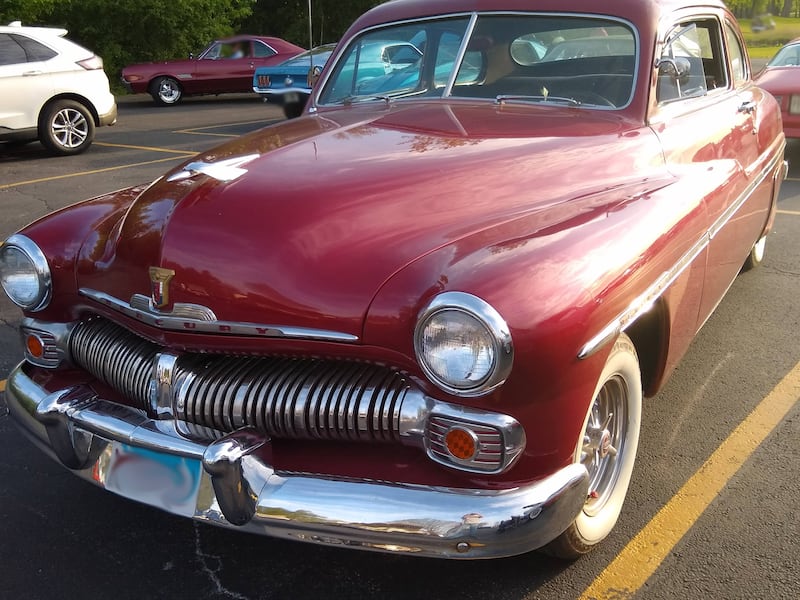
Like so many classic car stories, the story behind how Joe Bockwell found his prized 1950 Mercury 2-door sedan involves a little bit of luck mixed with some persistence. While out driving about a mile or so from his home, not looking for another car or something to collect, he drove past a home with its garage door open, and inside was the unmistakable shape of a 1950 Mercury.
After driving around the block for another look at the car, Joe says he saw the homeowner doing yard work, parked, and approached him about the Mercury. The homeowner explained that the classic did not belong to him. His neighbor, Wayne, who had passed away about three years ago, owned it, and he had passed it on to his son, who was not into cars.
:quality(70)/cloudfront-us-east-1.images.arcpublishing.com/shawmedia/HRESKV5UJFGJBPSMHYR7LMDI7U.jpg)
After contacting Wayne’s son, Joe struck a deal to acquire the 1950 Mercury 2-door sedan. He had it towed to his own home and was disappointed when the car would not start. The seller said the car had run a few months earlier, and after some inspection, it turned out to be a simple ignition issue.
As it turns out, Wayne was into racing and a member of the North Shore Car Club. The main thing that Joe likes about the car, other than it’s a Mercury, is that it wasn’t ‘chopped.’ He says there aren’t many original 1950 Mercury’s that still have a full body. From what he found out, there are only a handful full bodied models left in Illinois. Joe’s version still has optional fender skirts!
:quality(70)/cloudfront-us-east-1.images.arcpublishing.com/shawmedia/Y5E3GPQU3VFNFLA55N5CQS7FHY.jpg)
The Mercury’s original Flathead V8 has been replaced with a late-model Chevy small block 350-cubic-inch V8 with an Edelbrock manifold and four-barrel carburetor. The ignition system has been upgraded with electronics, since the ignition system was the problem with the car to start with. The exhaust system has factory Chevy cast-iron manifolds and dual exhaust pipes. Chrome tips finish it off at the rear. The transmission is a TH350 with a B&M floor shifter. The differential is the original that came with the car, a 4.27:1 unit.
Joe said he is very happy to have found a car whose body has not been touched. He believes the crimson hue is the car’s original color, as he cannot find a single spot that would indicate otherwise.
:quality(70)/cloudfront-us-east-1.images.arcpublishing.com/shawmedia/3XSPPL4GSJG3TP2LTDIPLM5OUY.jpg)
The interior is reupholstered, a two-toned leather, gray and black, with the same bench seat installed at the factory. The dashboard is all there, down to the cigarette lighter. Manual crank windows all work as they should. The radio is still in there, although it doesn’t work anymore. There are some aftermarket gauges mounted under the dashboard. The tilt steering column is from a late-model Chevy. The electrical system has been upgraded from a 6-volt system to 12 volts.
Joe explained that the suspension has been rebuilt with new shocks and steering components. Joe says, “it rides and drives like a dream.” The car has been upgraded to have power steering and power disc brakes. The car rides on 15-inch wheels and radial tires. The rims are old school Cragers with ‘spinner’ center caps.
:quality(70)/cloudfront-us-east-1.images.arcpublishing.com/shawmedia/7W35J6ITMJCWFBODCPHL25ZSNE.jpg)
Joe says that the 1949 and 1950 models are almost identical, with the exception of the back windows. The ‘49 has a three-piece rear window, where the ’50 had one-piece glass. He also said that some of the rebuilders prefer to use the ‘50 back glass.
:quality(70)/cloudfront-us-east-1.images.arcpublishing.com/shawmedia/FI7GUQJ3LJBAHCRZVH7OXZVONA.jpg)
Joe likes to take his Mercury to as many car shows as he can. Sometimes he has to take one of his other cars in his collection if he can’t get this one out.