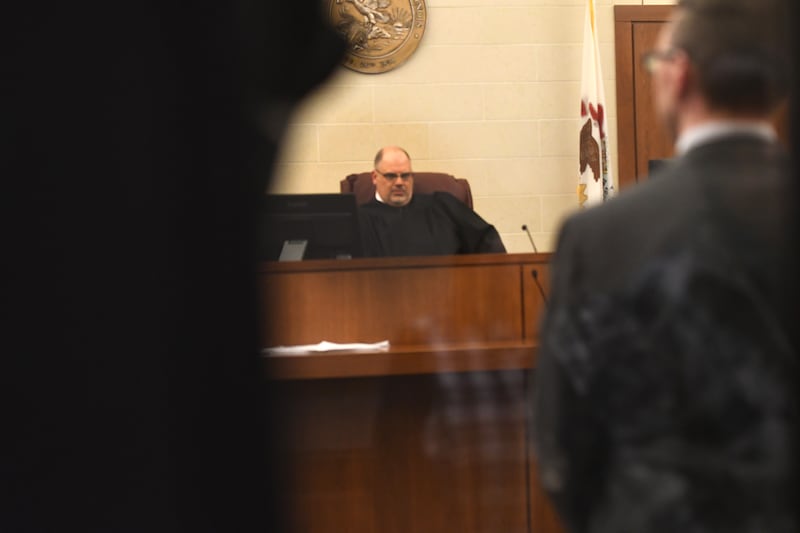
Ogle County jurors will enter their third day of deliberations on Wednesday, Jan, 28 as they continue to weigh evidence and arguments in a 2016 double-murder and arson case.
The jury is deciding the fate of Duane “DC” Meyer, 43, of Stillman Valley who is accused with killing his ex-wife, Maggie (Rosko) Meyer, 31, and then setting her Byron home on fire with their 3-year-old son, Amos, asleep in an upstairs bedroom.
:quality(70)/cloudfront-us-east-1.images.arcpublishing.com/shawmedia/ZVYHP2JREVGRHLPH3C3XPIQLHI.jpg)
Meyer, known as DC, was charged in 2019 with four counts of first-degree murder, two counts of aggravated arson and one count of concealment of a homicidal death in connection with the deaths. He has been held in the Ogle County Jail since his arrest on Oct. 9, 2019.
Prosecutors have argued that DC strangled Maggie to death and set her on fire in her home to clear the way for him to pursue a new life with his girlfriend.
But DC’s defense attorney, Christopher DeRango, has argued his client is innocent and that police unfairly targeted him instead of trying to find out who really was responsible for the deaths of Maggie and Amos.
Maggie was a teacher at the Chana Education Center at the time of her death. She filed for divorce in 2014, and court records show the divorce was finalized in September 2016.
Her charred body was found on a couch in her living room on Oct. 19, 2016. Pathologists determined her death to be “highly suspicious for homicide” testifying for the prosecution that she was strangled to death before the fire spread upstairs, killing Amos from carbon monoxide poisoning as evidenced by soot in his airway and lungs.
No soot was found in Maggie’s airway or lungs, but pathologists testified that there were signs of strangulation and “some type of blunt force trauma” on other parts of her body.
They said they could not determine an exact cause of death because the condition of her severely charred body – with no distinguishing features remaining – could have masked other injuries that made the case challenging.
The 8-woman, 4-man jury began deliberating at 1:45 p.m. Monday after hearing closing arguments from attorneys that culminated eight days of testimony.
The jury resumed deliberations on Tuesday morning, but just 40 minutes later, Ogle County Judge John “Ben” Roe called attorneys and DC back into the courtroom to notify them that jurors had asked two questions.
Roe said one of the questions was: “Is the interview of DC with the officers considered witness testimony?”
A week earlier, on Tuesday, Jan. 20, prosecutors played a recorded interview from Oct. 28, 2016 in which Meyer vehemently denied claims from two investigators that he was at Maggie’s home the night before her body was found inside the burned home.
The 4-hour recording was entered into evidence when prosecutors called Chuck Davidson, a former investigator and master sergeant with the Illinois State Police, to testify about the recording he and Ogle County Detective Doug Lockard made when Meyer was interviewed Oct. 28, 2016 – nine days after Maggie’s and Amos’s deaths.
Roe asked attorneys their position and suggestions as to how the court should reply to the request.
Assistant Ogle County State’s Attorney Allison Huntley said Roe should tell jurors that Meyer was not under oath when he responded to officer’s questions.
“The statements are testimonial and can be used against him,” argued Huntley.
DeRango said the entire record was entered in as evidence by the state and should be considered substantive in nature.
Ogle County State’s Attorney Mike Rock told Roe that the court needed to make sure that jurors realized DC’s statements should not be considered the same as other witness testimony that is made under a sworn oath to tell the truth.
“My thoughts are to make it simple so as not to confuse the jury,” replied Roe.
“They should consider the statements of the defendant as they would any other evidence pursuant to the jury instructions,” replied DeRango.
“His statement is different because it was wasn’t given under oath,” Rock said.
Roe said he would instruct the jury to follow the jury instruction that they should consider the statements of the defendants as they would any other evidence.
The second question asked: “Could DC’s demeanor in this interview and his responses be evidence of this case?”
Roe said the answer to that question was “yes”.
The jury then resumed deliberations at 10 a.m.
At 1 p.m., Roe called attorneys and DC back into the courtroom to notify them that jurors had requested a digital copy of the state’s CAST records to view on a large TV screen.
After a short discussion, the state copied those slides on to a thumb drive and it was given to the jury.
On Jan. 21, prosecutors showed slides of the FBI’s Cellular Analysis Survey Team (CAST) maps. FBI Special Agent Jeremy Bauer said that the FBI generated the slides based on Verizon cellphone data extracted by police from DC’s phone. He said that data indicated where DC’s phone was by tracking communications sent to and from cell towers in the area.
Bauer said a Historical Cell Site Analysis provided a general idea where the phone was at a certain time and place based from radio transmissions between the phone and the tower. That information is kept by major phone companies for billing customers and monitoring reception and performance, Bauer said.
Data gathered does not provide an exact address or determine who is making the calls or writing the text messages, he told jurors.
Bauer said the maps shown to jurors were created in April 2025 after he received the original report – created in 2016 – from an FBI agent who retired in January 2025. He said the report was also updated in October 2025.
The maps showed times and towers that Bauer said DC’s cellphone was used the day before and the day when Maggie’s body was discovered. He said a Real Time Tool is used by Verizon to establish when calls are made and measurements between the tower and phone.
The data showcased timestamps when the phone communicated with cell towers near Byron, Stillman Valley and the Rockford area. The maps also showed locations of DC’s home in Stillman Valley, his parents’ home on Hales Corner Road, and Maggie’s house.
DeRango questioned the state’s evidence and testimony from Bauer as to the exact location of DC’s phone and the method used to extract and retain data taken from it. He urged jurors not to rely on any of the records or the agent’s testimony.
Jurors also asked for a clarification of circumstantial evidence. Roe referred them to the jury instruction that they had received and deliberations continued.
At 4:27 p.m., Roe said received another question from jurors. “It reads as follows: ‘What would be a recommendation at this point in deliberations not 100 percent agreeance (sic) with some form of a break? Possibly coming tomorrow? Etcetera?’,” said Roe.
“As always I get input as well from attorneys. It’s 4:35 p.m.. They’ve been here since 8:45 a.m.”
Rock asked Roe to clarify if they wanted a break or wanted to go home now. Roe said he would clarify their request.
When he returned to the courtroom, Roe said the jury that the group just wanted to come back tomorrow (Wednesday) at this point of discussions if possible.
“So, I am not hearing anything about being deadlocked in any way,” Roe said. “Considering the circumstances I think that is the right thing to do.”
Roe honored that request noting Monday and today were very long days for jurors.
Jurors were instructed to be back at the Ogle County Judicial Center at 8:45 a.m. with deliberations beginning at 9 a.m.
Visit shawlocal.com for updates.
:quality(70)/author-service-images-prod-us-east-1.publishing.aws.arc.pub/shawmedia/c70d24f0-1332-4244-8446-e91288029474.jpg)