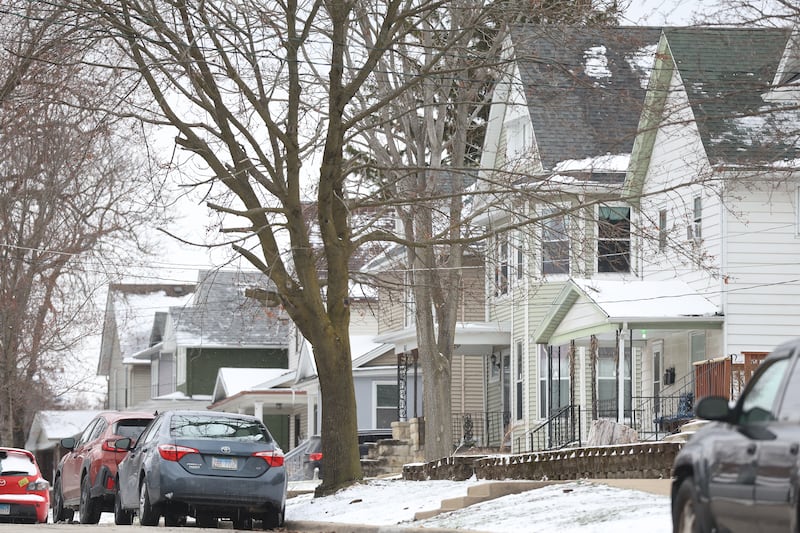
Illinois residents looking to become homeowners often struggle to get enough money saved for a down payment, a main cause for the national median age of the first-time homebuyer reaching an all-time high.
Gov. JB Pritzker’s administration recently launched a new program it believes will help ease that strain.
The Illinois Housing Development Authority Access Home program provides eligible Illinois homebuyers with up to $15,000 for assistance on a 30-year, fixed-rate mortgage on existing homes and new construction, as reported by Capital News Illinois.
The assistance is provided as a zero-interest silent second mortgage.
Repayment is deferred for up to 30 years or earlier if the homeowner sells or refinances, according to reporting by Capital News Illinois.
Eligibility criteria include the home’s purchase price, household income, and a credit score of 640 or higher, according to the IHDA website.
“Your home also has to be located in Illinois and be your primary residence,” said Conor Brown, interim chief executive officer of Three Rivers Association of Realtors.
And homebuyers must use one of IHDA’s approved lenders.
:quality(70)/cloudfront-us-east-1.images.arcpublishing.com/shawmedia/HRWJQVCDTFGGLJIBDBRIH3EROM.jpg)
Brown said the Access Home program is “a good positive boost” for first-time homebuyers.
“They have been particularly feeling the squeeze over the past few years as home prices have dramatically risen,” he said.
Rob Slovin, regional manager and senior vice president of mortgage lending at Guaranteed Rate, stressed that “first-time homebuyer” doesn’t mean someone who’s never owned a home.
“It’s somebody who’s not owned a home in the last three years,” Slovin said.
That criterion is for anyone on the loan, including the spouse, Slovin said.
Guaranteed Rate is a Home Access-approved lender.
Home ownership a net positive on communities
The national median age for Americans buying their first home is 40 years old, according to the National Association of REALTORS®.
The age was 32 just 15 years ago, Brown said, and that’s eight more years people must defer building equity and even generational wealth.
The National Association of Realtors conducted an analysis from the Federal Reserve Survey of Consumer Finance and learned that average homeowners are 43 times wealthier than average renters.
“Homeowners have a net worth of $430,000 versus $10,000 for renters,” Brown said. “So if you want to create a substantial amount and pass it on to your family, then become a homeowner.”
Home ownership also benefits and stabilizes the community, he said.
“The higher home ownership rate, the more stable the community is,” Brown said. “You have lower crime. You have better-looking homes and yards. You have a better quality of life all the way around.”
:quality(70)/cloudfront-us-east-1.images.arcpublishing.com/shawmedia/FIMQFTN6IFGFBLMLVYISFTEVZE.JPG)
‘Skin in the game’
Slovin praised the Home Access program because the biggest issue people face when qualifying is money.
“They don’t have any,” he said.
Oftentimes, homebuyers can afford the monthly payments, they just can’t save for the down payments, Slovin said.
The $15,000 assistance with the Home Access program is just a new version of previous IDHA programs that provided less funds, he said.
“It just wasn’t enough anymore,” Slovin said. ..
Under the new provisions, homebuyers will still need to contribute to the down payment at 1% of the purchase price.
“You have to have some skin in the game,” Slovin said.
The maximum purchase of the home must be approximately $664,000 and household income must be around the $132,000 mark – although those exact numbers vary by county, Brown said.
The only downside Slovin sees in the program is that the homebuyer must repay the funds at some point.
“But if you stay there 20 years, you’ve got $15,000 for free for 20 years – no interest," he said. “It’s pretty sweet.”
While the assistance is in essence “free money,” Slovin said, “if you don’t need it, don’t take it. If you got $30,000 of your own to put down, you don’t need it.”
:quality(70)/cloudfront-us-east-1.images.arcpublishing.com/shawmedia/VRTCX326BBFY5J5Z5OLWNWXWBY.jpg)
Housing supply still an issue
Tammy Batson, an economics instructor at Northern Illinois University in Dekalb, said lack of down payment funds isn’t the homebuyer’s main obstacle – it’s the housing supply.
“There’s just not enough houses being built,” she said.
Batson wants corporations to stop buying up single-family homes. She wants to see zoning reclassifications to foster new construction.
Finally, low interest rates might look good to the homebuyer, but they are preventing would-be sellers from parting with their homes, further contributing to the housing shortage, she said.
“To sell our house means we’d have to buy a new house,” Batson said. “And unless we can buy that with 100% cash, it means we are locking ourselves into higher interest rates. We’re buying a new house at a new or higher rate, which means I’m paying higher taxes, too.”
Funding for the Home Access program will come from “reallocated funds from prior down payment assistance programs, excess single-family indenture liquidity, and proceeds from future revenue bond debt issuances,” Capital News Illinois reported.
For more information, visit ihdamortgage.org.
:quality(70)/s3.amazonaws.com/arc-authors/shawmedia/59304215-cb18-46db-bced-9941d9413236.jpg)