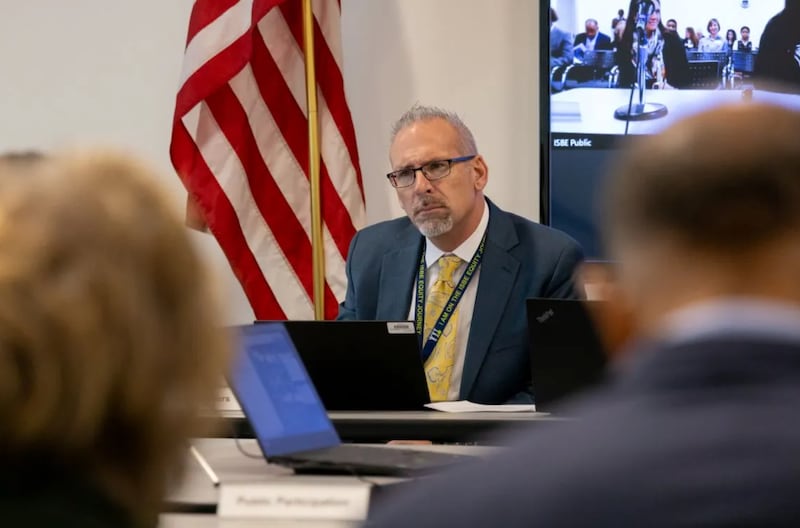
SPRINGFIELD – Illinois Superintendent of Education Tony Sanders cautioned members of the State Board of Education on Wednesday not to get their hopes up for any big increase in K-12 school funding next year.
With economic forecasts projecting little or no growth in state revenues over the next year and growing demands for increased spending in other areas of state government, Sanders said the budget proposal he plans to bring to the board in January is likely to be modest.
“I just want to level set for the board that as we bring in our budget proposal asking for an increase in education funding, it’s coming at a time there’s a lot of other fiscal pressures on state government,” Sanders said. “So we’re keeping that in mind in our preparation.”
Sanders’ comments came after the board heard a briefing on the state’s financial outlook for the year ahead as well as a summary of all the requests the agency has received for increased funding.
For the current fiscal year, spending on elementary and secondary education is expected to total just under $11.2 billion, or about 20% of the state’s entire $55.1 billion General Revenue Fund Budget.
Officials from the Commission on Government Forecasting and Accountability, the nonpartisan fiscal staff of the General Assembly, told the board that economists are expecting weak job growth in the year ahead. They said that’s due in part to economic disruptions brought on by President Donald Trump’s tariff policy.
They also said lower interest rates could result in reduced revenue for the state. And there is great uncertainty about how much money the state can expect to receive from the federal government due to changes in federal budget policies.
“So, the bottom line overall is that without notable growth expected in the state’s primary resources, and with no significant one-time revenue streams on the horizon, … a relatively stagnant revenue outlook probably should be anticipated this fiscal year,” COGFA’s revenue manager Eric Noggle said. “So it’s not the best news for fiscal year ’27.”
Education funding in Illinois
Under the Evidence-Based Funding plan that lawmakers passed in 2017, K-12 education spending is supposed to increase by at least $350 million each year, with the new money targeted to the most underfunded school districts. That includes $300 million for direct educational expenses and $50 million for property tax relief grants in high-tax districts.
But the K-12 education budget also includes funding for costs outside the EBF formula, known as “mandated categorical” expenses. Those include transportation costs, special education expenses and funding for the state’s free lunch and breakfast program.
Due to budget limitations, for the last several years the state has funded only a prorated portion of those costs, leaving local school districts to pay the remainder out of their own revenues.
For the current fiscal year, the state budgeted to spend $1.17 billion for those mandated categorical expenses. But Andy Krupin, ISBE’s director of funding and disbursements, said preliminary estimates show it will take an additional $151.5 million next year just to keep the state’s prorated percentage of funding the same.
Wednesday’s briefings were just a preview of the official budget request that Sanders will present to the board at its next meeting Jan. 14. That request will be submitted to Gov. JB Pritzker, who will take it into consideration as he prepares an overall budget proposal that he will submit to the General Assembly in February.
Capitol News Illinois is a nonprofit, nonpartisan news service that distributes state government coverage to hundreds of news outlets statewide. It is funded primarily by the Illinois Press Foundation and the Robert R. McCormick Foundation.