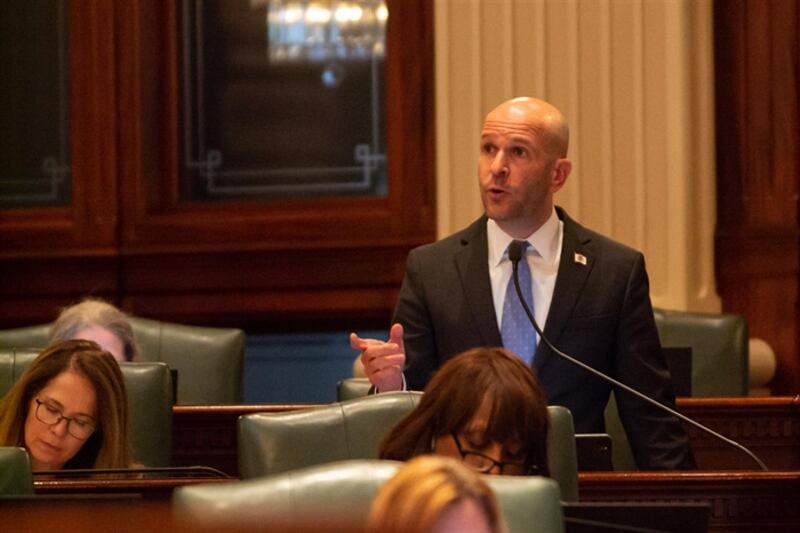
CHICAGO – Illinois lawmakers vowed to keep fighting for protections against artificial intelligence after President Donald Trump signed an executive order Thursday to shield tech companies from state laws.
Trump’s order targets state regulations, including several in Illinois, that he said are inconsistent with national policy on AI. Critics said Illinois will not be swayed by the influence of “Big Tech.”
The order calls on Attorney General Pam Bondi to establish an AI Litigation Task Force within 30 days to review state AI laws and sue those with regulations that undermine a national policy framework to promote “global AI dominance” for the U.S.
A spokesperson for Gov. JB Pritzker called the move “unlawful” and “a blatant federal overreach” in a statement to Capitol News Illinois. Pritzker’s office and Illinois Attorney General Kwame Raoul’s office each said they are reviewing the order and considering next steps.
“At a time when generative AI is taking over people’s screens and feeds – spreading harmful misinformation and raising serious concerns about its impact on mental health – Illinois is taking responsible, bipartisan steps to ensure artificial intelligence is integrated safely and ethically,” the governor’s spokesperson said, adding Illinois would continue advancing “common-sense” policies.
Illinois has passed laws regulating use of AI in mental health care settings, employment decision-making, community college instruction and digital replications of artwork and likeness. A law passed last year also amended state criminal code to clarify that child pornography laws apply to AI-generated photos and videos.
State Rep. Bob Morgan, D-Deerfield, accused the president of prioritizing tech companies above normal citizens. Morgan has sponsored several AI-focused bills in recent years.
“Under no circumstances will I allow Donald Trump or tech executives to decide whether families are protected from health insurers using AI to deny care or from predatory AI therapists targeting children,” Morgan wrote in an email. “Illinois won’t back down – we have both a constitutional right and a moral obligation to regulate artificial intelligence in health care, public safety and beyond.”
Framework of the order
The federal order framed the success of artificial intelligence companies as a national and economic security issue and highlighted the administration’s past efforts to remove barriers for the industry.
“We remain in the earliest days of this technological revolution and are in a race with adversaries for supremacy within it,” the order stated. “To win, U.S. AI companies must be free to innovate without cumbersome regulation. But excessive state regulation thwarts this imperative.”
The order also directed Commerce Secretary Howard Lutnick to explore whether federal funding for rural broadband can be withheld from states with “onerous” AI laws – a move the governor’s office called “reckless” and said “doesn’t protect anyone but the wealthy.”
The president wrote that the regulatory patchwork created by differing state laws makes compliance more difficult for AI companies, particularly startups. The order rested on the grounds that state laws may unconstitutionally regulate interstate commerce.
But beyond Thursday’s order, there is limited federal guidance for states to follow.
Despite introducing more than 100 bills this year to regulate AI, congressional lawmakers failed to pass any comprehensive legislation. In the absence of federal regulation, all 50 states, Puerto Rico, the Virgin Islands and Washington, D.C., introduced AI regulatory bills this year, with 38 states adopting about 100 measures.
“Some aspects of AI policy are appropriately addressed through a uniform federal framework, while others reasonably reflect state-level judgment based on local needs and circumstances,” state Rep. Daniel Didech, D-Buffalo Grove, wrote in a statement. “Any federal approach should respect that balance, support innovation and prioritize public safety over partisan interests.”
Reactions
Tech industry leaders welcomed the move, with venture capitalist and Trump’s AI advisor David Sacks posting a thank you to Trump on social media last week.
Sacks wrote that the federal AI policy would not force local communities to host data centers, and that state laws protecting children from online predators would remain in effect.
Sacks has faced criticisms for using his position to advance the investments of his firm, Craft Ventures, in crypto currency and AI-related companies.
Illinois lawmakers who have introduced bills to regulate AI said the order demonstrates undue influence in federal decision-making held by tech leaders like Sacks.
“We know how much influence they have on him [Trump] because now he has done this executive order,” state Sen. Mary Edly-Allen, D-Libertyville, told Capitol News Illinois. “What do they say? The proof is in the pudding? It’s validated that having all of these very powerful, very rich people has directly influenced his decision to write this executive order.”
The move drew mixed reactions from Trump allies, with multiple Republican governors voicing discontent.
“An executive order doesn’t/can’t preempt state legislative action,” Florida Gov. Ron Desantis wrote in response to Trump’s announcement. “Congress could, theoretically, preempt states through legislation.”
Illinois’ AI laws
So, what laws may be in the crosshairs in Illinois?
In August, Pritzker signed House Bill 1806, a law that prohibits licensed mental health professionals from using AI in therapy or psychotherapy counseling.
Morgan introduced the bill after he learned that patients using online counseling services were unknowingly interacting with AI chat-bots during sessions.
House Bill 1859 restricts community colleges from replacing human teachers as primary instructors with AI. House Bill 4762 and House Bill 4875 granted digital likeness protections to performers and artists, giving artists an avenue to take legal action for unpermitted replication of their work.
Edly-Allen, who sponsored both artist protection bills in the Senate, said the final bills ended up being narrower than she had originally hoped.
“Those are some really serious questions that we need to debate, like, do we own our likeness?” Edly-Allen said. “I believe it should be even extended to regular folks that we should be able to protect our identity and our voice from being stolen, just like our credit card.”
It was “gravely concerning,” Edly-Allen said, to strip away the narrow protections created for artists under those bills. In 2023, she also sponsored a measure allowing victims of “deepfake porn” to sue the creator of that material.
Edly-Allen praised the administration for passing the Take It Down Act earlier this year, a bill championed by First Lady Melania Trump that criminalized the distribution of AI-generated deepfake and revenge porn. The bill passed with broad bipartisan support, co-sponsored by Republican U.S. Sen. Ted Cruz of Texas and Democratic U.S. Sen. Amy Klobuchar of Minnesota.
An amendment to the Illinois Human Rights Act, House Bill 3773, prohibits use of AI in employment decisions such as recruitment, hiring and promotion if that use results in discrimination due to race, religion, sex and age.
The law, which goes into effect Jan. 1, will require employers to disclose use of AI in employment decisions.
House Bill 4623, introduced by Raoul, updated state criminal code to specify that child pornography laws apply to photos and images generated by AI.
Didech, who has sponsored multiple AI-related bills, said the guardrails passed by Illinois lawmakers respond to “real and documented” harms.
“Illinois will not be bullied into abandoning its responsibility to protect its residents,” Didech said.
Capitol News Illinois is a nonprofit, nonpartisan news service that distributes state government coverage to hundreds of news outlets statewide. It is funded primarily by the Illinois Press Foundation and the Robert R. McCormick Foundation.