On a warm August morning, Chicago Bears head coach Ben Johnson walked into the PNC Center at Halas Hall with a clear message. The Bears were set to hold a training camp practice later in the afternoon a couple days before hosting a joint practice against the Miami Dolphins.
Johnson started his opening remarks by telling reporters it would be the final day of playbook installation before warning of a shift that was about to occur.
“It will be a good, physical practice,” Johnson said on Aug. 5. “I know we toned it down for our guys yesterday, get their legs back underneath them. We’ll have a good one here today, player day off tomorrow, and then we’ll be on to Miami. This is a big one for us. Changing it from morning practice to noon, it’ll be a little bit hotter out there. I’m really expecting big things here from our guys.”
They didn’t expect it to turn out that way. The day was supposed to start with a couple periods of short-yard and goal-line work that involved some live tackling. That’s it.
But the physical play didn’t stop after the third period started. Both sides of the ball kept playing hard and the live tackling continued once they started 11-on-11 drills.
Defensive players were confused at first whether they should still be tackling. They asked each other whether it was all still live. Most training camp practices involved a couple live tackling sessions and that’s it. Since the coaches didn’t say to stop, the Bears defense just continued to go live.
“Ben kind of set a tone and said, ‘Hey, we’re going to be the most physical team in this division,’” veteran Bears safety Kevin Byard told Shaw Local News Network. “‘And if we’re going to be physical, we have to practice like that.’ I think guys really just kind of bought into that.”
It was a tone Johnson wanted to set when he and his coaching staff took over during the offseason.
When they first met with players during the spring, Johnson emphasized the importance of details in everything the Bears did. Players got glimpses into what that meant in the meetings and practices they held during organized team activities and minicamp over the spring.
But players didn’t truly understand the tempo and physicality Johnson wanted his players to practice with once that training camp practice in August started.
“That [practice] was a stepping stone of what we were capable of and what we plan on doing,” Bears right guard Jonah Jackson said.
:quality(70)/cloudfront-us-east-1.images.arcpublishing.com/shawmedia/Y3Q7TLZC7FGA7MURT36HYIDVJM.JPG)
It’s been the Bears’ identity in all three phases during their 9-3 start to the season that’d led them to the top of the NFC standings heading into Week 14. Chicago has bullied other opponents since its Week 2 blowout loss to the Detroit Lions as it’s won 10 of its last 11 games.
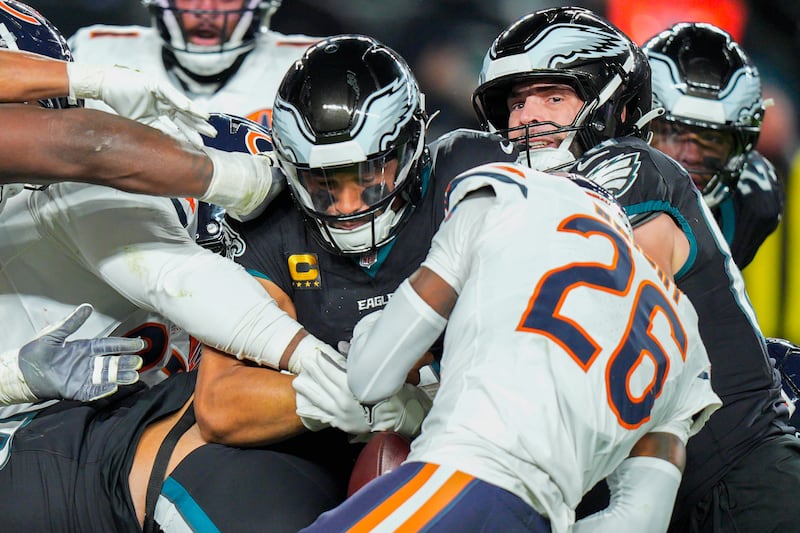
The Bears’ physical style got a national audience in their Week 13 win over the Philadelphia Eagles. Chicago’s offense set the tone with a dominant performance running the ball for 281 yards. But when you watched it live, it wasn’t just that running backs D’Andre Swift and rookie Kyle Monangai made nice cuts to produce long runs.
The offense physically blocked as a unit. Chicago’s offensive line pushed up the middle while the wide receivers, running back, tight end and even quarterback Caleb Williams all blocked on the sides.
“It took all of us,” Jackson said. “We got the initial push up front, but you see on the back end, safeties, cornerbacks, everybody’s getting blocked by wideouts, tight ends, [running] backs. We even had the [quarterback] making us look good too.”
Special teams and the defense showed off their physicality too. Elijah Hicks came up with a big hit on a kickoff in the fourth quarter after the Bears scored a go-ahead touchdown. Meanwhile the defense forced a three-and-out on the Eagle’s next drive thanks to some strong tackle by the defense.
“Ben kind of set a tone and said, ‘Hey, we’re going to be the most physical team in this division. And if we’re going to be physical, we have to practice like that.’ I think guys really just kind of bought into that.”
— Kevin Byard, Bears safety
Byard credited the Bears’ physical practice habits for their strong tackling. Chicago is tied for 25th in the NFL with fewest missed tackles at 63. Even when the Bears aren’t actually tackling in practice, Byard said they wrap up the player with the ball in order to get into the routine.
“We want to have a tough, physical mentality,” Bears assistant head coach and wide receivers coach Antwaan Randle El told Shaw Local News Network. “Not just your offensive line and defensive line. Your [running] backs and your linebackers, your tight ends got to be involved. Then your wide receivers got to be involved. Your [defensive backs] got to want to be willing to come up and block. I mean, a hit, tackle and everything. So it works all together. Then the quarterback shouldn’t be doing it. He does sometimes too.”
The Bears will lean on their bruising identity Sunday when they face the Packers at Lambeau Field. With all five remaining regular-season games outdoors, the physical edge they built in the offseason could prove decisive down the stretch
Johnson has stressed that past wins don’t guarantee future success, and the locker room has embraced that mindset. The Bears still have plenty to prove in their playoff push, and the habits forged over the past year will be the measure of whether they get there.
“It’s something that you have to prove every week,” center Drew Dalman said to Shaw Local. “Having done in the past doesn’t affect teams in the future. So you’ve got to show up every week and be prepared every week to play physical. It feels good when it works out for us. But it also just means we have to continue our habits and kind of trend the right way.”
:quality(70)/author-service-images-prod-us-east-1.publishing.aws.arc.pub/shawmedia/eb89d2f0-2de7-4151-81f5-2c7ea0de9d1d.jpg)