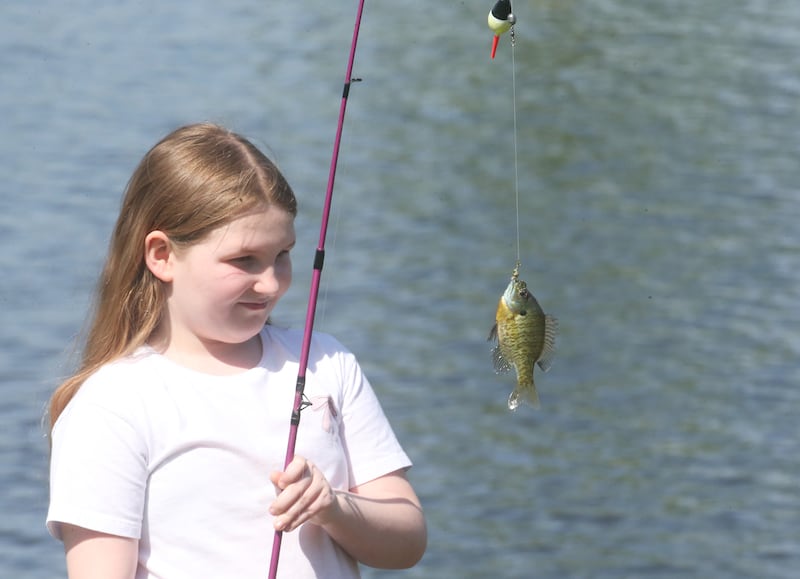
Caught any fish lately at Baker Lake in Peru? Have you noticed the bluegills and sunfish are smaller than in years past?
There are complex reasons why the fish aren’t as big: Baker Lake has become shallower and the resulting conditions make it harder for some fish to thrive. Peru officials are doing something to reverse those conditions, which were years in the making.
Monday, the Peru City Council voted to approve a proposal from Herman Brothers Fisheries for lake improvements at Baker Lake at a cost of $14,944.09.
“This is a really good step forward for Baker Lake,” Mayor Ken Kolowski said.
Eric Carls, city engineer, said the immediate plan is to introduce a dozen grass carp to assist with long-term vegetation control and replace the few aging grass carp.
The new carp aren’t there solely for anglers to catch: their job is to consume the vegetation and organic materials, such as fallen leaves, that have accumulated upon the lake’s bottom and decreased the overall depth of the pond.
“The shallower the water, the quicker it can heat up in the summer, which stresses or can kill fish,” Carls explained. “The warmer water will have less oxygen in turn, making it difficult to sustain aquatic life.
“Additionally, the shallower water allows the sunlight to reach the bottom more easily, which then causes excess weed, plant, and algae growth. Shallower ponds also naturally have less habitat to promote a healthy fish population.”
Other fish besides carp will be introduced. City staff plan to add 1,000 pure bluegill and 200 channel catfish annually for about three years.
Those are the natural improvements. There is a mechanical improvement, too. The city will install aerators at the bottom of Baker Lake.
:quality(70)/cloudfront-us-east-1.images.arcpublishing.com/shawmedia/AERVO6H255EBNMFNICIB2D4BB4.png)
The diffusers will help introduce more oxygen, which will in turn accelerate the breakdown of the organic materials that have accumulated on the lake’s bottom. It will also help reduce the nutrient load that is driving the significant algae growth.
“In time, not immediately but in a couple of years, the aerators will result in a depth increase of 12 to 18 inches,” said Adam Thorson, parks director.
Anglers will reap some short-term benefits. While the lake’s largemouth bass population is “very healthy,” Carls said, there were no catfish observed during a recent lake survey. While a “good population” of red ear sunfish and hybrid bluegill was found, these panfish were mostly smaller.
These improvements won’t yield overnight results, but they are decidedly cheaper than dredging, which Carls said would require “a significant capital investment.”
“A plan to dredge the lake may not be out of the question long term,” Carls said. “However, at this time we are focusing on and exploring more cost-effective solutions to help improve the overall quality of the lake.”
:quality(70)/s3.amazonaws.com/arc-authors/shawmedia/638ad18c-1176-4018-bcef-b5560cf36d58.png)