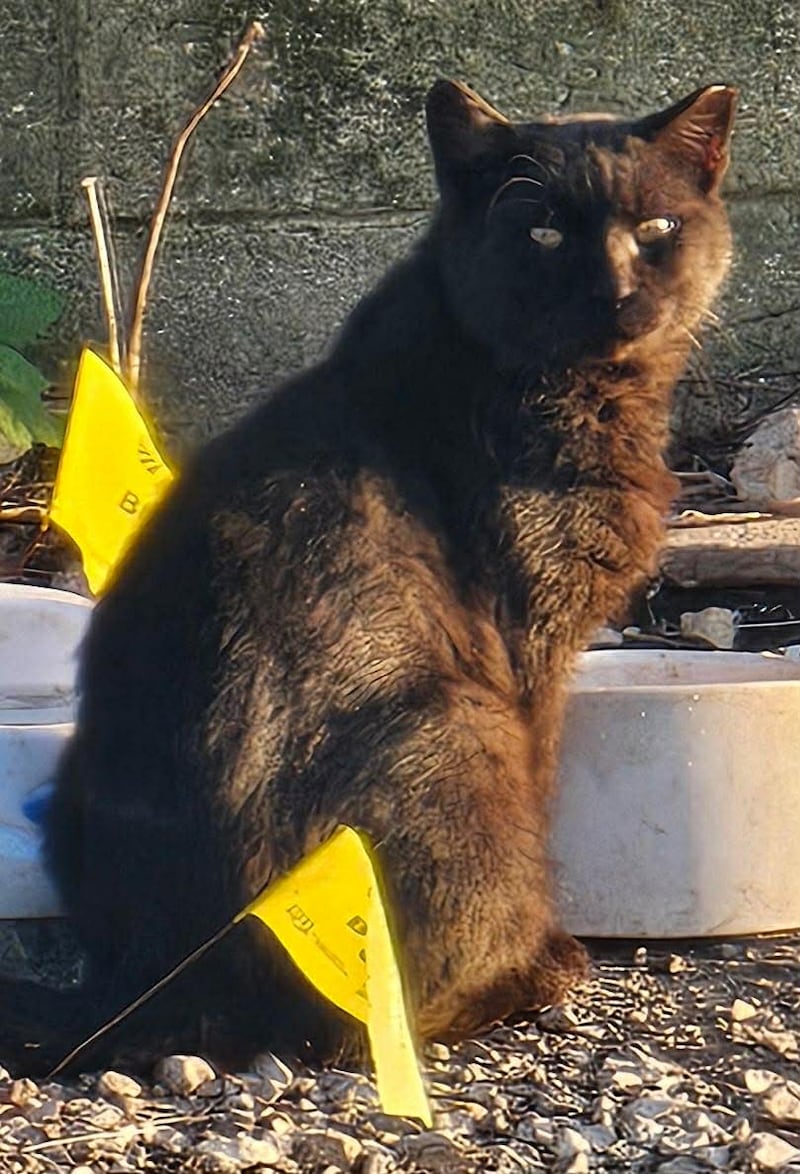
The ordinance stands: Feed a feral cat in unincorporated La Salle County, and you could be fined $75.
But there have been behind-the-scenes discussions between county authorities and the Safe House Animal Rescue League, which opposes the ban on feeding feral cats. Although the two sides have not yet reached an agreement, they’re working on one.
Sandy Knott of Safe House Animal Rescue League said she and her advocates have a meeting set in mid-January with the La Salle County Sheriff’s Office. She’s hoping to come out with a way to protect feral cats without punishing those who feed them.
“Long term, the ordinance [and $75 fine] would need to be rescinded,” Knott said, “and a proper ordinance put in place to protect the feral cats.”
:quality(70)/cloudfront-us-east-1.images.arcpublishing.com/shawmedia/2IWMID6XPNEW5IMOJYC7WHIK7Y.jpeg)
One of the board members engaged in the discussions to date, Brian Dose, D-Ottawa, said he, too, hopes to reach a compromise. That said, the $75 fee isn’t simply coming off the books, and he’s mindful of residents who’ve been clear: They don’t want those animals fed.
Dose said the ordinance and fine are not being actively enforced – “No one’s out headhunting” – and that the board will consider any agreement worked out between the sheriff’s office and Safe House. Discussions will resume in 2026, but he doesn’t foresee the ordinance simply being rescinded.
“Having nothing on the books is not an option,” Dose said. “Hopefully, we can find a middle ground.”
Meanwhile, Knott provided Shaw Local with two La Salle County residents who’d been feeding feral cats and, to hear them tell it, successfully engaged in trap-and-release practices to prevent reproduction while treating the animals humanely.
Shaw Local agreed to grant anonymity to those who feed feral cats. One of the concerns raised was the possibility of incurring the $75 fine, but the primary concern was revealing the location of feral cat colonies, which could jeopardize the animals’ safety.
:quality(70)/cloudfront-us-east-1.images.arcpublishing.com/shawmedia/TH2LUUDWNFDBXDXOS4H6AVZE64.jpeg)
A Peru woman granted anonymity said that earlier this year, she had noticed a half-dozen feral cats along with a pregnant female cat. Concerned the population could explode and spawn problems – “This could really spiral out of control real fast,” she remembered thinking – she did online research and then contacted Knott.
Once armed with traps and with a local veterinarian willing to spay and neuter the feral cats, she was able to return the males to the wild in little more than a day. The after-care for the pregnant female took longer, although it, too, was released.
“So, I was able to get a colony of nine fully fixed,” the Peru woman said. “There were three females, so there won’t be any more babies, and the males won’t be running around. It was a lot of hard work, and it was stressful, but it was really worth it.”
The animals are significantly more tame since being spayed and neutered.
“My neighbors might have regarded them as a nuisance, but now the cats don’t wander, they don’t fight, they don’t spray,” she said. “They’ve calmed down and become really docile. They just come to my house and eat.”
A rural Peru woman reported similar experiences. She, too, spotted feral cats and worried that the population would explode. After some investigation, she trapped and released 11 feral cats (including two females) and six kittens.
“My neighbors told me, ‘We are totally behind you. Do what you have to do,’” she said.
The rural Peru woman also observed the feral cats living “more harmoniously” with one another since being spaying and neutered, “where before they were fixed there was fighting, and they showed up with wounds.”
“The more I do, the more I learn, and the more I believe this is needed,” she said. “I can’t afford fines. I don’t want the pets to get into the hands of the wrong people. I don’t want them to be trapped and euthanized. I would miss them. I would be heartbroken.”
Although the Peru woman was not out any out-of-pocket costs for veterinary care, she emphasized that trap-and-release requires patience and perseverance. Cats cannot be counted on to arrive at a particular time, even when accustomed to regular feedings, and it’s important to build trust with the animal before conducting trap-and-release practices.
In that context, the Peru woman said La Salle County’s prohibition on feeding feral cats is unproductive and shortsighted.
“To say you can’t feed them at all? That’s just a big mistake,” she said. “It’s a big disservice to everyone.”
:quality(70)/s3.amazonaws.com/arc-authors/shawmedia/638ad18c-1176-4018-bcef-b5560cf36d58.png)