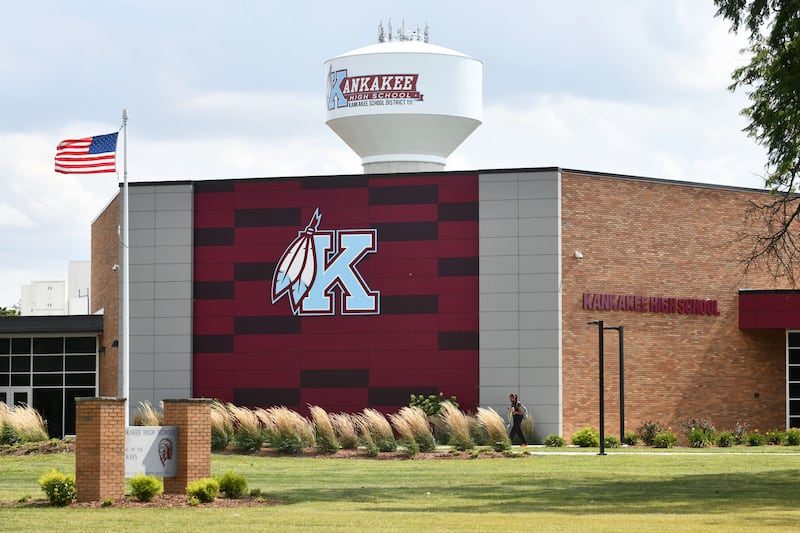
When it comes to curriculum, Kankakee schools have homework to do.
The Kankakee School Board heard a report Monday on the District 111 curriculum audit completed by Curriculum Management Solutions, Inc.
The company began the audit in March 2024. The cost for the services was $130,332.
Holly Kaptain, of CMSi, reviewed the findings of the audit, which resulted in a 250-page report.
The audit centered on five focus areas and included six recommendations.
“The most central issue really is student learning,” Kaptain said.
Vision and accountability
The district’s curriculum policies are compliant with state requirements, but they are not sufficient to fully direct curriculum implementation, the report said.
“Your curriculum policies are pretty sparse,” Kaptain said.
Kaptain said it is a good thing the district has already set a strategic planning process in motion, as this is needed.
Curriculum
The audit found the district has no written direction for curriculum design, development, delivery and assessment.
“There’s an older curriculum management plan in place that’s from five or six years ago that is pretty obsolete,” Kaptain said. “It’s there; it’s not being followed.”
Kaptain said the district’s curriculum is more defined as resources available for teachers, rather than something the district has developed to guide teachers.
The resources are not aligned to the Illinois Assessment of Readiness or the ACT, both tests used to measure students’ proficiency and growth.
“Even if teachers are teaching those with fidelity, they are not going to get the learning at a high enough level for students to succeed on those assessments,” Kaptain said.
The resources, particularly at the elementary level, are also overwhelming in scope for teachers.
For example, teachers have almost 4,000 pages of materials just for third-grade English language arts.
Consistency and equity
The report found weak alignment between district expectations and daily instructional practice.
Instructional delivery was found not to be engaging or student-centered.
“Teaching in classrooms is mostly whole-group, direct instruction, and students were observed most of the time doing seat work,” Kaptain said. “It was pretty low-level, so it was not super cognitively demanding.”
It found that most core subject instruction was formed around classroom context, rather than real-world context.
Overall, student engagement was not supported with authentic, quality curriculum and resources.
“This is no condemnation of teachers,” Kaptain noted. “This is really about teachers doing the best they can with what they’ve been provided.”
Furthermore, the report found that not all students have equal access to programs and services.
Students of color, especially Black students, are less likely to be identified as gifted and enroll in Advanced Placement courses and are overrepresented in special education and disciplinary referrals.
Assessment
The report found gaps in student assessment data and a lack of planning and direction for assessment and the use of data across the district.
However, assessments are being used, like the STAR test and district-developed common formative assessments.
“That’s a real strength, so we want you to continue to do that and to really build on those,” Kaptain said.
Productivity, finances
The report concluded that District 111 is well-resourced but hasn’t done a cost-benefit analysis in its budgeting practices.
“Increased costs to maintain aging buildings, transporting students across the district in support of school choice, and wasteful spending have contributed to budget deficits and low fund balances,” the report summary read.
Additionally, auditors did not find evidence that technology is used effectively, with no formal process in place to select, implement and evaluate programs.
Recommendations
In order of priority, the auditors’ recommendations were:
- Establish a clear vision for what learning should look like in classrooms.
- Establish curriculum documents that help teachers navigate resources, define what mastery looks like and help teachers make better choices from the resources.
- Develop clear guidelines for monitoring and supporting the delivery of curriculum in alignment with the district’s vision.
- Connect financial management practices to educational priorities; monitor spending for alignment to student learning and develop a facilities plan to prepare for future needs.
- Focus assessment on performance-based measures that are authentic and rigorous; improve the quality of the assessment instruments and provide guidance for using data.
- Develop a technology plan and system for evaluating programs to improve productivity district-wide.
Going forward
Kelly Gilbert, assistant superintendent for curriculum and instruction, said the district has plans to begin discussing and implementing some of the auditors’ suggestions in the second semester.
“We are not waiting,” Gilbert said.
Gilbert said the district will receive a final report from the auditors before winter break.
The final report will further break down the findings and identify next steps.
Kaptain said the goal is to make better use of the resources, expertise, and capacity already in place in classrooms.
Teachers should be working smarter, not harder, she added.
“You are at such an important crossroads as a board,” Kaptain said.